When you visit a new country it's nice to try new things. I was looking forward to experiencing a new culture for a few years instead of a few weeks. From what I had seen on our initial visit I was going to love the food, the climate and the natural environment. But having been here for 6 weeks there are a few things that I miss. There are too many to cover from A-Z in one post so I'll start from the beginning. There were no A's, so here are my B's
Basements - They don't have basements in South Africa. The ground never freezes so foundations don't need to be poured below the frost line. I knew I wasn't going to have a basement when we picked this house. I packed accordingly and stored accordingly and I think I got the amount of stuff I brought just right. It's not the storage space I miss. I miss the fact that the basement used to be the kids play space. Not long before we left DD turned 5. She was mostly independent and DH and I had started getting Saturday mornings to sleep in a bit. The kids would go down stairs to the kitchen. The boys would help their sister get cereal for breakfast and then they'd go to the basement to play. 2 floors and sound insulation made for nice quiet mornings to get some extra shut eye. On all the other days of the week if the kids got crazy with friends and toys and I just didn't feel like cleaning up one day (okay, who am I kidding one month), I closed the door and it magically disappeared for a while. Out of sight out of mind, right?
Well, we have 2 lounges (South African vernacular not mine). One on the main level and one just at the top of the stairs. The lower lounge is really just one half of a giant open concept kitchen/dining/living space. Not the kind of place you want all the kids toys to be. So by default the Wii, piano, books and toys all went upstairs. Fantastic, out of sight of the guests. Unfortunately, right outside mommy and daddy's master bedroom door. Sigh. So much for our lazy Saturday mornings and no such thing as out of sight out of mind either.
On the up side we're up early enough on Saturday mornings that we can get on the road to all the fun and exciting things we want to do.
Bisquick - I have this stew recipe that I love. It's from the Eat, Shrink and Be Merry cookbook by the Podleski sisters from Canada. We love it so much that when we were here in February I actually checked to see if they had Herbs de Provence in PE. I couldn't find it so I shipped 2 bottles of my own in the suitcase so I could make the recipe authentic. What I didn't check for was the Bisquick that makes the dumplings on top. We've had the recipe twice now and I have used dumpling mix as a substitute, but it's not the same. It was easy to use the Bisquick to make up pancakes if the kids wanted them or cheesy biscuits for a snack with lunch. I know, I could have made them from scratch, but really it was so versatile and it was always a good fall back plan on those days I didn't know what to cook for supper. Hey kids how about pancakes? Yeh! So I will need to start making my biscuits from scratch. Not a big deal, but it's something I never thought I would miss.
Breakfast sausages - You know the ones. The little tiny links that are maple syrup and brown sugar flavoured. The ones that are all juicy (yes I know it's really just fat) and sort of explode when you poke your fork into them. They don't have them here. Not that I've found yet at any rate. All the sausages here are savoury not sweet. They have pork, lamb, beef, chicken, and kudu sausages, but all of them are savory and all of them are hot dog sized. The closest I have come to finding sweet has been honey with mustard, not your typical breakfast fair. So, I will keep looking, but it may just be one of those things that I ask mom or dad to buy when we come home for Christmas.
Next Post - Birds of Eden - Part One (Back to the touristy stuff)
Tuesday, 7 June 2011


Monday, 6 June 2011
It's not my house.
Right. Let's take a break from the touristy stuff for a post or two and get back to the nitty gritty of moving half way around the world.
I have never rented before. I don't count University residence as renting. I moved from my parents home directly into a house that dh and I had purchased just before the wedding and then we upgraded to a bigger place once the children came. I have always had a say in how things are done and who does them. I have been able to turn my house into my home, whether it was my room at my parents or in my own house. I've been able to upgrade or not depending on our bottom line and generally, whatever I did increased the value of our home, so it was money well spent and it made the house more mine.
This is not my house. This is a rental and it's not even my name on the lease. It's a great house, we picked it and I love it, mostly. The house was a vacation property for the owner and they hadn't used it in almost 3 years when we moved in. Kind of nice to have a mostly brand new home but there are things that weren't done and noticed without someone living here.
If you know me, you know that I am a go getter. That I am not a sit back and wait kind of person. I have been in PE for 6 weeks now. By 4 weeks in I was a cub scout leader. I knew many of the staff at the school by first name. I had offered to help with the school production of Pinocchio. I joined SAALED (South African Association for Learning and Educational Differences) and attended their congress in central PE. I'll be volunteering in the grade 1 class beginning in July because the grade one teacher wants to pick my brain about all my volunteer time in Canada. I've spoken to the volunteer coordinator at the local animal shelter and am waiting until I have some free time to spend a morning a week at the shelter helping out where I can. That's on top of all the laundry, taxiing, tutoring, grocery shopping, a new blog and various other tasks of a mother of 3. Patience is not one of my strengths.
So, here's my problem. How do I make a house that's not mine a home that is? I can't go and get the things that are needed for this house. It's not up to me. We have a lease and a property manager, who has to clear everything with the owner. Then a contractor needs to show up and assess, then write a quote. Then the quote needs to be submitted to the property manager who then has to clear it with the owner. Then we have to wait until the contractor has time to show up and fix the problem. Meanwhile, there is a colony of ants inhabiting the broadloom in DS#1's bedroom, and the paint is peeling from the walls due to water damage. Neither of these or the other little things on my list of deficiencies is life threatening. It doesn't make the house unlivable, but I can't put curtains up in ds #1's room because the screw holding up the curtain rod rusted through from the water damage. There is no point in putting up artwork or kids photos if it's not painted.
If I hire someone to fix something on my own, like the ant problem, and the carpets get damaged or something untoward happens, technically, I am not responsible. It isn't my name on the lease, but the company becomes responsible and obviously I can't let that happen. If I upgrade the gardens or curtains, it may be adding value to the house, but it's not my value. It's not my house, but it has to be my home for the next 2 - 4 years.
So I am struggling to come to some kind of compromise between my go getter self and the reality of my situation. How do I balance making it a comfortable home for my family without making too many changes to the house. The place will be painted, eventually, when the water damage is fixed. The company had offered to do that before I found the damage, as the walls have nail holes and such from the previous owners. I've even picked out the paint. It will be lovely, someday, sigh.
I waffle back and forth from day to day on decisions like; Do I really want to replace the 8 panels of fully lined orange drapes in the open concept living area or can I live with them? Do I replace the weed field in the backyard and re-sod or seed? Could I live with my environmental self if I followed the advice of the garden service guy and use a broad leaf herbicide to kill all the weeds and give the lawn room to grow?
I've always said that home is where our family of 5 (and dog) is. I must believe that or I never would have agreed to this move. Still, in the end I want to live in a home that I can be proud of, that I can invite family and friends to visit and they will know that it is my home, not just a house that we live in.
It's not my house, but I hope someday (soon) it will feel like my home.
Next Post - Things that I miss and never thought I would. (The B's)
I have never rented before. I don't count University residence as renting. I moved from my parents home directly into a house that dh and I had purchased just before the wedding and then we upgraded to a bigger place once the children came. I have always had a say in how things are done and who does them. I have been able to turn my house into my home, whether it was my room at my parents or in my own house. I've been able to upgrade or not depending on our bottom line and generally, whatever I did increased the value of our home, so it was money well spent and it made the house more mine.
This is not my house. This is a rental and it's not even my name on the lease. It's a great house, we picked it and I love it, mostly. The house was a vacation property for the owner and they hadn't used it in almost 3 years when we moved in. Kind of nice to have a mostly brand new home but there are things that weren't done and noticed without someone living here.
If you know me, you know that I am a go getter. That I am not a sit back and wait kind of person. I have been in PE for 6 weeks now. By 4 weeks in I was a cub scout leader. I knew many of the staff at the school by first name. I had offered to help with the school production of Pinocchio. I joined SAALED (South African Association for Learning and Educational Differences) and attended their congress in central PE. I'll be volunteering in the grade 1 class beginning in July because the grade one teacher wants to pick my brain about all my volunteer time in Canada. I've spoken to the volunteer coordinator at the local animal shelter and am waiting until I have some free time to spend a morning a week at the shelter helping out where I can. That's on top of all the laundry, taxiing, tutoring, grocery shopping, a new blog and various other tasks of a mother of 3. Patience is not one of my strengths.
So, here's my problem. How do I make a house that's not mine a home that is? I can't go and get the things that are needed for this house. It's not up to me. We have a lease and a property manager, who has to clear everything with the owner. Then a contractor needs to show up and assess, then write a quote. Then the quote needs to be submitted to the property manager who then has to clear it with the owner. Then we have to wait until the contractor has time to show up and fix the problem. Meanwhile, there is a colony of ants inhabiting the broadloom in DS#1's bedroom, and the paint is peeling from the walls due to water damage. Neither of these or the other little things on my list of deficiencies is life threatening. It doesn't make the house unlivable, but I can't put curtains up in ds #1's room because the screw holding up the curtain rod rusted through from the water damage. There is no point in putting up artwork or kids photos if it's not painted.
If I hire someone to fix something on my own, like the ant problem, and the carpets get damaged or something untoward happens, technically, I am not responsible. It isn't my name on the lease, but the company becomes responsible and obviously I can't let that happen. If I upgrade the gardens or curtains, it may be adding value to the house, but it's not my value. It's not my house, but it has to be my home for the next 2 - 4 years.
So I am struggling to come to some kind of compromise between my go getter self and the reality of my situation. How do I balance making it a comfortable home for my family without making too many changes to the house. The place will be painted, eventually, when the water damage is fixed. The company had offered to do that before I found the damage, as the walls have nail holes and such from the previous owners. I've even picked out the paint. It will be lovely, someday, sigh.
I waffle back and forth from day to day on decisions like; Do I really want to replace the 8 panels of fully lined orange drapes in the open concept living area or can I live with them? Do I replace the weed field in the backyard and re-sod or seed? Could I live with my environmental self if I followed the advice of the garden service guy and use a broad leaf herbicide to kill all the weeds and give the lawn room to grow?
I've always said that home is where our family of 5 (and dog) is. I must believe that or I never would have agreed to this move. Still, in the end I want to live in a home that I can be proud of, that I can invite family and friends to visit and they will know that it is my home, not just a house that we live in.
It's not my house, but I hope someday (soon) it will feel like my home.
Next Post - Things that I miss and never thought I would. (The B's)
Sunday, 5 June 2011
Monkeyland - Part Two
In the last post you met the squirrel monkey, and brown capucian from South and Central America and the Black lemur from Madagascar. There were other primates at Monkeyland and other things that I learned along the way.
Did you know that monkey's, with their prehensile tails, can hold a piece of fruit curled in the end of their tail when their hands are too full? We saw them do it.
Or, that squirrel monkey's use their nimble little fingers to turn over every leaf, stone, or stick to reach the bugs underneath? Even the we little babies knew how to do it.
We learned about the grandfather of Monkeyland. Well, Godfather is probably the better term. He and another male had come to Monkeyland from a European zoo. When his buddy died, leaving him alone, he adopted the squirrel monkey's as his new family. He came to their defense at every need against the bullies of the forest and the visitors who got too close. The squirrel monkey's worshiped him, the others were afraid of him. We were told that he was a bit of a recluse and he certainly made no effort to be easily seen. He was calm, poised, almost stately and he is a Spectacled Langur monkey.

Spectacled langurs are named such because of the white circles around their eyes that resemble spectacles. They are native to Thailand.
We learned that Brown capucian monkeys are kind of trouble makers. As we were watching a black and white ruffed lemur lounging in a tree, a capucian came up underneath him and grabbed his tail in play. It was a strange scene to witness, a lemur and a monkey swinging and screeching through the trees above us. Two species playing together.
Here is a relaxed black and white ruffed lemur before the chase.


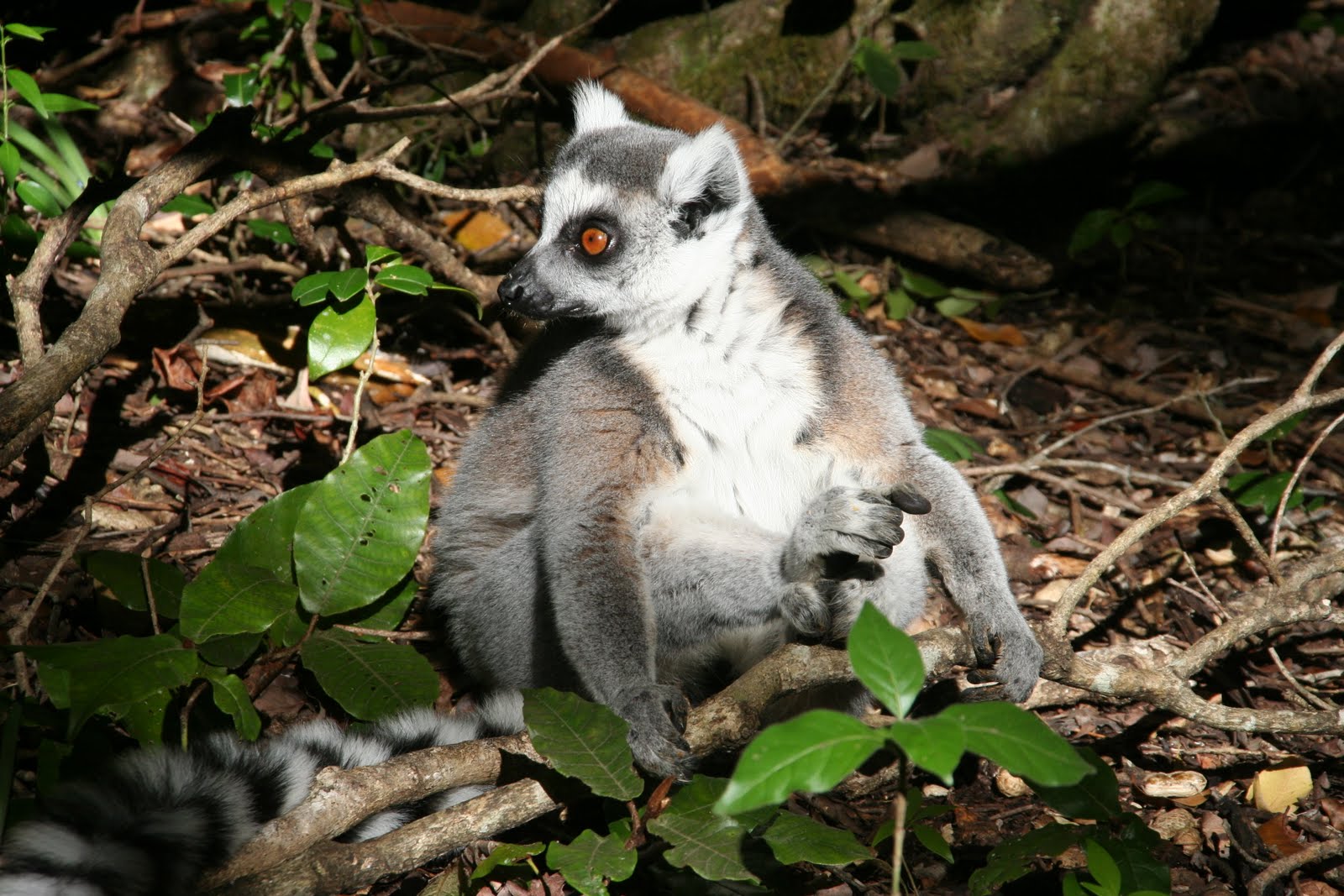
In the same part of the sanctuary lived the ring tailed lemurs. Those of you with children who watched TVO or CBC would know Zabu, from Zaboomafoo, is a ringtailed lemur. Lemurs are primates, with divergent digits on their hands and nails (primates have nails not claws), like monkeys, but they don't have prehensile tails, so they can't swing by their tails in the trees. Like the Black lemur, ruffed and ringtailed lemurs come from Madagascar.
Here is our Zabu.

Nearing the end of the guided walk we came to the suspension bridge. Monkeyland claims that the bridge is the longest suspension bridge in Africa at 128m. Here's a view of the family on the way over the bridge.

The last of the free monkey's that we saw on the tour were on the other side of the bridge. They were the Vervet monkey's and the only species in the sanctuary native to South Africa. These are the ones that live around our house. One day a Vervet decided that our neighbours fruit bowl was laid out just for him, so he swung through the open patio door and helped himself. It caused quite a ruckus when their 11 year old daughter found him in the kitchen and started screaming. Anyway, this is what they look like when they aren't raiding the neighbours fruit bowl.

The last monkey's on the tour were in one of the quarantine cages. They were two Howler monkey's who were waiting to be released into the main forest area. It was surprising to see the difference in colour between the male and female when all the other species male and female looked very similar. The guide told us that a Howler monkey call could be heard for almost 5km and that they are native to Central and South America.
This is the male Howler.


Next post - It's not my house.
Did you know that monkey's, with their prehensile tails, can hold a piece of fruit curled in the end of their tail when their hands are too full? We saw them do it.
Or, that squirrel monkey's use their nimble little fingers to turn over every leaf, stone, or stick to reach the bugs underneath? Even the we little babies knew how to do it.
We learned about the grandfather of Monkeyland. Well, Godfather is probably the better term. He and another male had come to Monkeyland from a European zoo. When his buddy died, leaving him alone, he adopted the squirrel monkey's as his new family. He came to their defense at every need against the bullies of the forest and the visitors who got too close. The squirrel monkey's worshiped him, the others were afraid of him. We were told that he was a bit of a recluse and he certainly made no effort to be easily seen. He was calm, poised, almost stately and he is a Spectacled Langur monkey.

Spectacled langurs are named such because of the white circles around their eyes that resemble spectacles. They are native to Thailand.
We learned that Brown capucian monkeys are kind of trouble makers. As we were watching a black and white ruffed lemur lounging in a tree, a capucian came up underneath him and grabbed his tail in play. It was a strange scene to witness, a lemur and a monkey swinging and screeching through the trees above us. Two species playing together.
Here is a relaxed black and white ruffed lemur before the chase.

Here is a black and white ruffed lemur with a capucian on his tail.

Here is our Zabu.
Nearing the end of the guided walk we came to the suspension bridge. Monkeyland claims that the bridge is the longest suspension bridge in Africa at 128m. Here's a view of the family on the way over the bridge.

The last of the free monkey's that we saw on the tour were on the other side of the bridge. They were the Vervet monkey's and the only species in the sanctuary native to South Africa. These are the ones that live around our house. One day a Vervet decided that our neighbours fruit bowl was laid out just for him, so he swung through the open patio door and helped himself. It caused quite a ruckus when their 11 year old daughter found him in the kitchen and started screaming. Anyway, this is what they look like when they aren't raiding the neighbours fruit bowl.

The last monkey's on the tour were in one of the quarantine cages. They were two Howler monkey's who were waiting to be released into the main forest area. It was surprising to see the difference in colour between the male and female when all the other species male and female looked very similar. The guide told us that a Howler monkey call could be heard for almost 5km and that they are native to Central and South America.
This is the male Howler.

This is the female.

After spending an hour with monkeys and lemurs moving freely around us, it was a little sad to see these two in their cage. It helped knowing that they would be released eventually, and it made me glad that Monkeyland was there to allow these amazing primates to roam relatively free.Next post - It's not my house.
Saturday, 4 June 2011
Monkeyland - Part One
For about 6 months before we left for South Africa, DD was terrified of the "M" word. Yup, you got it, we couldn't even say the word monkey without her starting to freak out. This was not a good thing just before moving to Africa. We decided she needed to be desensitized. So we took her to the Monkeyland website and showed her all the cute pictures of the wee little monkey babies. It worked like a charm.


Brad is a Black Lemur. Brad was enjoying a lazy morning in the sun, when the guide told us that he was born in Canada. His mate had died a few years back and he was the only one of his kind in the park.


With our psychiatric intervention complete we were able to visit Monkeyland, which is a really cool place. It's the world's first multi-species free roaming primate sanctuary. It is set in a forest where monkeys and lemurs who have been pets or raised and used for circuses, movies or zoos, all over the world, are brought. The have 3 quarantine areas where new residents are housed in large cages containing trees among the free monkeys. They are quarantined for health reasons, but also because most of them have never had the opportunity to learn to climb trees or how to be monkeys.
The park itself is surrounded by a 14 foot high fence that only one of the monkey species can climb high enough to get out of, though I can't remember which one at the moment.
We were just waiting for the tour to start when one enterprising little squirrel monkey snuck in the cafe door past an unsuspecting visitor and ran straight for the sugar packets on the table. He was pretty ingenious about it. He started by getting close and playing peek a boo on top of the table umbrella, keeping a keen eye on the door as all of us visitors ooooh'd and ahhhhh'd. The second the door was opened by someone distracted by what we were all looking at, he blew through the door, grabbed the packet and was shooed back out by the server.
Here's the sugar addict with his prize.

Next we met Brad.

A lonely Brad, obviously, felt an immediate kinship with his fellow Canadians because as the group moved off Brad joined his Canadian peeps at the back of the pack for a walk. That's his tail just to the right of DD#2's legs.

He stayed with us for 100m or so before he melted into the forest.
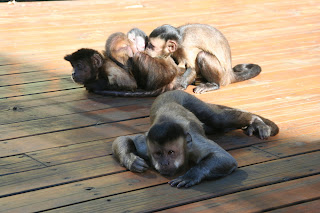
The largest population in the park belongs to the Brown Capucian monkey. Unbelievably cute, which is why so many of them are bought as pets and used in ads and movies. We were told that the brothers and sister's carry infant siblings on their backs and take care of them while mom goes out to flirt with all the big daddy type capucian's. That's why they are the most abundant in the park. We got some time to get really close to a group of them. It was amazing to see how expressive they could be.
This is curious.

This is, back off lady you are waaaaay to close to my sister.

You can't tell from the picture, but this was not a full grown monkey. This was a juvenile taking care of a younger sibling. The infant was about 5-6" long. The eyes were still closed, but somehow those fingers grabbed hold of the older ones fur and it shifted it's weight instinctively with every step or movement that was made under it. I was amazed by it. I have a ton of photos of it.
It was never more clear than when I was watching that little group of siblings and cousins that there is some connection between us and them.
It wasn't just that I'd had that same, back off lady, expression on my own face a time or two.
It wasn't this shot of one, nursing a bleeding wound on another.

It was this one, of big cousin giving a tender puckery kiss to new baby cousin while big brother mopes because his baby sister is getting all the attention and he's been left behind at the kids table, again.

If that isn't a typical extended Canadian family dinner then I'm a monkey's uncle.
Next Post - Monkeyland - Part 2 - Zabu and friends
Friday, 3 June 2011
Tanikwa Wildlife Awareness Centre - Meerkats and Marabou's
The last part of our time at Tanikwa was self guided. We were led to the meerkat enclosure and bird pond.
Now, I had caught glimpses of Meerkat Manor on the television back home every so often. I have recollections of them standing up on their hind legs, very still, watching for predators. These Meerkats were not still at all. They were little, and they were fast! It was really hard to get a good photo of them because they kept chasing our feet as we walked past. I have lots of blurry shots, not so many clear ones. One thing DS #1 commented on was how perfectly their feet were designed for digging. He figured the long, strong, curved claws could move a lot of dirt quickly.


Now, I had caught glimpses of Meerkat Manor on the television back home every so often. I have recollections of them standing up on their hind legs, very still, watching for predators. These Meerkats were not still at all. They were little, and they were fast! It was really hard to get a good photo of them because they kept chasing our feet as we walked past. I have lots of blurry shots, not so many clear ones. One thing DS #1 commented on was how perfectly their feet were designed for digging. He figured the long, strong, curved claws could move a lot of dirt quickly.

DD just thought they were "soooooooooooo cute".

Just beside the meerkats were Marabou Storks. The marabou is the largest in the stork family and it shares the distinction of having the largest wing span of any land dwelling bird with the Andean Condor. It is a carrion feeder much like vultures and for that reason has a bald (mostly) head. The soft downy feathers have been used for hats.

The Blue Crane is the national bird of South Africa. Commercial forests and civilization have been encroaching on it's natural habitat for decades and they are now endangered and their habitat severely restricted. (That's just a shadow accross the beak. It's not really darker)

Tanikwa has several Blue Cranes and as they are part of the conservation and breeding program their wings are clipped to prevent flying. As we were walking through the cat exhibit earlier in morning the guide pointed to, what he thought was a hawk eagle, until we heard the distinctive Blue Crane call and the Tanikwa cranes answered it. Our guide was shocked that it was flying so high. He had never actually seen one that high in flight before.

It was a rare treat according to the guide, so we spent as long as we could watching and listening.
Next post - Monkeyland. - Part One
Thursday, 2 June 2011
Tanikwa Wildlife Awareness Centre - The Cats
Our first stop of the weekend was Tanikwa Wildlife Awareness Centre. Tanikwa has a wild cat sanctuary and a number of native birds and meerkats. They also have a rehabilitation Centre that accepts any injured, abandoned or displaced wild animals from along The Garden Route. Animals are treated, cared for and when ready, returned to the wild.
They have numerous up close and personal interactive experiences, like a sunset walk with the cheetah's. The only problem was that there was a height restriction of 1.5m. We were told, on arrival, that though the cats were used to humans they are still wild cats and anything smaller than 1.5m could be seen as prey. So, since none of the kids met the requirement, we did the only "experience" available to us, The Wild Cat Experience. It was a 1 hour guided tour around the facility to see indigenous wild cats and other endangered wildlife.
We were introduced to the Centre through a video that explained how natural habitats were being effected by construction and commercial forestry. How animals were being hunted for parts and the carcasses left to rot. How farmers were shooting (and killing) endangered wild cats for attacking livestock. A couple of the photos were graphic, but true, and the picture of the dead rhino with no horn was as disturbing as it was meant to be. There was a greater message of hope however, that this generation could and was making a difference through education and conservation. Their tag line is "we are the last generation who can make a difference".
Wild cats go for the kill by biting the neck to sever the jugular vein. There was a display of safety collars both plastic and metal that could be fitted around the necks of livestock to protect them and our guide told us of educational awareness programs to educate farmers that killing endangered wild cats was not necessary. There was also a poster pleading that travellers not purchase porcupine jewelry. It has become commonplace for porcupines to be killed for all of their quills rather than the past practice of picking up quills that had already been shed in an effort to feed the demand for porcupine jewelry. Because of this change in practice the porcupine is a threatened species here.
After the video we were instructed to take off anything dangly that might be mistaken for a toy by the cats. Our sunglasses had to be removed too, as the cats do not like it when the cannot see the eyes of what has entered their enclosure. We were also warned not to look directly at any of the cats as it would been interpreted as a challenge.
With all of our gear stored, our first stop was the African wild cat. We entered the enclosure with the guide and were told that the children should stay close to the grown ups in order to look like one large animal instead of several smaller ones. Now, African wild cats are quite small, in line with a really big house cat in Canada. Why they are endangered is that they have been mating with common house cats and creating feral cats. The actual pure gene pool of the wild cat has become very small thus endangering the survival of the species.
Here is an African wild cat. Being nocturnal it was happily sleeping when we visited.


They have numerous up close and personal interactive experiences, like a sunset walk with the cheetah's. The only problem was that there was a height restriction of 1.5m. We were told, on arrival, that though the cats were used to humans they are still wild cats and anything smaller than 1.5m could be seen as prey. So, since none of the kids met the requirement, we did the only "experience" available to us, The Wild Cat Experience. It was a 1 hour guided tour around the facility to see indigenous wild cats and other endangered wildlife.
We were introduced to the Centre through a video that explained how natural habitats were being effected by construction and commercial forestry. How animals were being hunted for parts and the carcasses left to rot. How farmers were shooting (and killing) endangered wild cats for attacking livestock. A couple of the photos were graphic, but true, and the picture of the dead rhino with no horn was as disturbing as it was meant to be. There was a greater message of hope however, that this generation could and was making a difference through education and conservation. Their tag line is "we are the last generation who can make a difference".
Wild cats go for the kill by biting the neck to sever the jugular vein. There was a display of safety collars both plastic and metal that could be fitted around the necks of livestock to protect them and our guide told us of educational awareness programs to educate farmers that killing endangered wild cats was not necessary. There was also a poster pleading that travellers not purchase porcupine jewelry. It has become commonplace for porcupines to be killed for all of their quills rather than the past practice of picking up quills that had already been shed in an effort to feed the demand for porcupine jewelry. Because of this change in practice the porcupine is a threatened species here.
After the video we were instructed to take off anything dangly that might be mistaken for a toy by the cats. Our sunglasses had to be removed too, as the cats do not like it when the cannot see the eyes of what has entered their enclosure. We were also warned not to look directly at any of the cats as it would been interpreted as a challenge.
With all of our gear stored, our first stop was the African wild cat. We entered the enclosure with the guide and were told that the children should stay close to the grown ups in order to look like one large animal instead of several smaller ones. Now, African wild cats are quite small, in line with a really big house cat in Canada. Why they are endangered is that they have been mating with common house cats and creating feral cats. The actual pure gene pool of the wild cat has become very small thus endangering the survival of the species.
Here is an African wild cat. Being nocturnal it was happily sleeping when we visited.

Next was the leopard. His enclosure is not accessible for close up interaction. It's wasn't hard to understand why, when we saw the size of the claw marks on the trees that he loves to climb. We were told that this is the expression he gets when he is sizing up a little DD for a meal.

The thing that struck me the most about the leopard was the size of his paws. They were huge in comparison to his body. It wasn't hard to imagine how big the claws would be if you looked at the paws and calculated about how far back a retracted claw would go. Truly bone chilling stuff.
Next we met the Caracal. What a beautiful creature. He was really "friendly" with us. You know how a house cat will come up and rub itself against your legs, well that's just what this little boy was doing. He was pushing his way in between us and rubbing our legs. The guide told us that they do this to mark their territory and try to cull the smaller members of the group away by getting in between us. DS #2 kept trying to reach down and pet the "nice kitty". Thankfully dh and I were instructed to hold the children's hands, so it wasn't an issue. The guide kept moving the cat away so that we could walk without tripping over him. He was a beautiful and sleek cat reminding me of a small cougar or mountain lion, except for the ears. It was hard to take a good photo given that he was so "friendly", but here it is.

Next was the Serval. Sometimes they are mistaken for a young cheetah or leopard. They are sleek and build for speed and jumping, like cheetah's, but eat small rodents not larger animals.

We were then escorted into the cheetah enclosure. They were still juveniles and fully grown, but not fully filled out. Park policy is to have a second guide to locate them and assess their mood while our guide stayed with us. We were lucky that they were in a good mood. As we approached the female was very alert. When we stopped walking closer she started to purr. It was by far the most memorable part of the experience at Tanikwa to hear the deep throaty purr of this gorgeous creature. In the end she was relaxed enough to groom herself a little in our presence.

The male was much more alert and wary than the female, you can tell from his look.

The guide told us that leopards and cheetah's were often confused with each other because of their spotted coats. After seeing them up close, it is easy to see that the big paws, wide head and thick stocky muscled body of the leopard is built for jumping, climbing and pulling carcasses up into trees to eat. Cheetah's are really quite dainty in comparison. Thin, tall, small paws, and build for speed on the ground.
Next Post - Tanikwa Wildlife Awareness Centre - Meerkats and Marabou's
Wednesday, 1 June 2011
B & B in The Crags
So when we looked at the website for the B&B I loved the line "Canadian styled log chapel". I mean I just had to see thier interpretation of Canadian Style. Here it is.

Now, I can't speak for other B&B's in South Africa, but this one sure was different than I was used to. The one's I've experienced in Canada are usually a home that has been converted in some way and everyone has a bedroom, sometimes shares a communal bathroom and has breakfast in a communal kitchen. Not so on our weekend away. There was a "host" family who had a home on the property and they welcomed us and invited us into the garden, and the kids into the house but that was all.
We had a seperate cottage with 2 rooms joined in the back by a bathroom and a self catering kitchen (equipped to cook you're own meals), beside it. Due to a "blown geyser"(I'm still not entirely what a geyser is, but oh well) the kids carpet had gotten wet and was still drying out when we got there. The place was booked full the second night so they couldn't put us anywhere else. It was livable and we really didn't spend much time there with all the activities we did.


We had a seperate cottage with 2 rooms joined in the back by a bathroom and a self catering kitchen (equipped to cook you're own meals), beside it. Due to a "blown geyser"(I'm still not entirely what a geyser is, but oh well) the kids carpet had gotten wet and was still drying out when we got there. The place was booked full the second night so they couldn't put us anywhere else. It was livable and we really didn't spend much time there with all the activities we did.

The roofs were thatch, (which proved to be waterproof on our second night there) and the walls were painted brick. It was very quaint.

No need for the mosquito net in the winter.
We managed our own dinner, but breakfast was served in the little kitchen. Bacon, scrambled eggs, toast, juice, coffee and boerwoers. Boerewors are Boer (Farmer) Wor (Sausage) in Afrikans. They are a beef sausage, and in my experience very lean. Dh loves them, me, I prefer a maple and brown sugar pork sausage for breakfast (Mmmmmmmm). I haven't found those here yet.
The property had multiple little cottages all over the place some for 2 people, some for more and one small block with several rooms on the first floor and a honeymoon suite up above.
The property was gorgeous. A huge duck pond and lots of space for the kids to run around. We had the place to ourselves the first night and the owners 3 year old had a blast playing with our kids. The owner said there didn't tend to be too many kids through the winter. The property was fully fenced and the duck pond too due to the age of the owners son, so the kids could safely play without mommy and daddy on top of them the whole time and we had some breathing room too.

The bar was fantastic asthetically.

Overall, a very enjoyable stay and a very new experience for a B&B.
Next post - Tanikwa Wildlife Awareness Centre
Subscribe to:
Posts (Atom)